
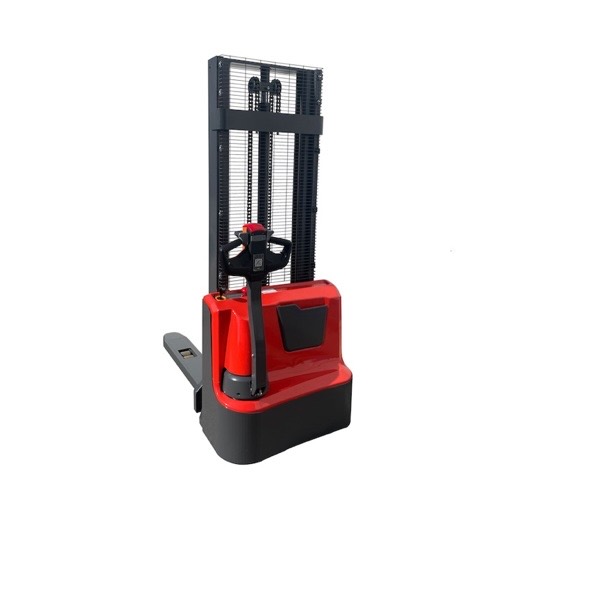
Most people start by asking how much the truck lifts. That is the wrong first question. Capacity is usually the easiest requirement to meet — aisle width is the one that eliminates half the catalogue before you have finished reading it.
Work through these six in order.
1. Measure your aisle first
Every stacker spec sheet gives an Ast figure: the minimum aisle width the truck needs to turn, enter a pallet and set it down. It is given twice, because it depends on how the pallet sits:
- Pallet 1000 × 1200 mm across the forks
- Pallet 800 × 1200 mm along the forks
The two numbers are not the same, and the difference is not always in the direction you expect. On one of our 1.5 t stand-on models the across-forks figure is 2,410 mm and the along-forks figure is 2,430 mm; on another it is 2,250 and 2,190. Check the line that matches the pallet you actually use.
Then add working clearance. An Ast of 2,250 mm in a 2,300 mm aisle is arithmetically fine and operationally miserable — every pallet becomes a three-point turn. Give yourself 200–300 mm over the spec figure.
Across our stacker range the Ast values run from about 2,190 to 2,530 mm. If your aisle is under 2,200 mm, you are not looking at a stacker; you are looking at a pallet truck plus a separate lifting solution, or at reconfiguring the racking.
Turning radius (Wa) is the related number, and it varies more than people expect: 1,340 mm on our 2 t stand-on model, 1,410 mm on the centre-drive SE series, 1,570 mm on the E series. A 230 mm difference in turning radius is the difference between a truck that fits your end-of-aisle turn and one that does not.
2. Lift height: h3 is the number, h1 is the constraint
h3 is the lift height — how high the forks go. That is the number you were looking for.
h1 is the height of the mast when it is fully lowered, and it is the number that will actually cause you a problem. Every extra metre of lift adds mast, and mast has to fit under something: your lowest doorway, the shutter into the loading bay, and the container door when the truck is shipped.
As a rough guide on a two-stage mast, each 500 mm of extra lift adds roughly 250–300 mm to the lowered mast height. On our E series, a 2,600 mm lift comes with a 1,786 mm lowered mast; a 3,600 mm lift comes with 2,286 mm. That 500 mm matters if your door is 2,000 mm.
The third number is h4, the height of the mast fully extended. Check it against your ceiling, your sprinkler heads and your lighting. A 3.6 m lift on a two-stage mast typically extends to just over 4 m.
Two more heights worth a glance:
- h13 — lowered fork height, typically 86–90 mm. If you handle closed-bottom pallets or skids, check this.
- h14 — tiller height in the driving position, usually given as a min/max pair (for example 970/1330 mm). Operator comfort, not clearance.
Free lift (h2) is zero on most standard stackers. If you need to lift a pallet inside a container or under a low beam without the mast growing, you need a free-lift mast — that is a different specification, so say so up front.
3. Capacity, and the trap in it
Rated capacity (Q) is quoted at a load centre (c) of 600 mm — a standard 1200 mm pallet loaded evenly. Two things break that assumption.
Long or unevenly loaded goods. If the centre of gravity sits further out than 600 mm, real capacity drops, and faster than most buyers expect. If you handle 1,800 mm long items, ask your supplier for the derated figure — do not scale it yourself.
Capacity at full height. On some designs, particularly double-lifting stackers, the mast carries less than the chassis. One of our double-lifting models is rated 1,500 kg overall but only 800 kg on the mast in its tallest configuration. That is a legitimate design, not a defect — but if nobody tells you, you find out the hard way.
Round up, but not wildly. A 2 t truck in a 1 t job costs more to buy, weighs more (740 kg against 550 kg on comparable models), needs a wider aisle and puts more load on your floor.
4. Pedestrian or stand-on
This is a labour question, not a machine question.
Pedestrian (walkie) — the operator walks behind the tiller. Lighter (from 550 kg), narrower, cheaper, and perfectly adequate when the truck moves pallets ten metres at a time. Below about 20 metres per run, the operator walks faster than the truck usefully drives.
Stand-on — a fold-down platform with restraint arms. Travel speed rises from around 4.2 to 5.5 km/h laden, and more importantly the operator stops getting tired. Adds roughly 100–200 mm to overall length and typically 50–150 kg to service weight.
The honest test: how many metres per hour does this truck travel? Under 500 m, buy pedestrian and spend the difference on a better battery. Over 1,000 m, buy stand-on — you get the money back in throughput within a year.
5. Battery: the decision that costs the most over five years
Lead-acid, 24 V — the default. On a 1.5 t stacker a 24 V/120 Ah pack handles a single shift with normal duty. Cheap to buy, needs watering, needs a ventilated charging area, and wants a proper charge cycle rather than opportunity top-ups. Expect three to four years.
Lead-acid, 48 V — higher voltage, lower current for the same power, which means less heat and better performance on ramps and long runs. Our 2 t stand-on model runs 48 V.
Lithium — charges in gaps, no watering, no dedicated charging room, and no capacity loss at the end of a shift. Costs more per truck. It is worth it when either of these is true: you run more than one shift and cannot spare a swap, or you have no ventilated battery room and building one would cost more than the battery premium.
For a single-shift warehouse with a charging corner, lead-acid is still the rational choice. Ignore anyone who tells you lithium is always the answer.
6. Floor, ramps and thresholds
Three specs get overlooked, and all three come back to bite.
Gradeability — laden/unladen, given as a percentage. Typical values are 3/6% to 6/10%. A loading dock ramp is often 8–10%. If yours is, say so before you buy, not after.
Ground clearance (m2) — typically 26–35 mm at the centre of the wheelbase. On broken concrete, expansion joints or dock plates, that is not much.
Wheels — polyurethane is standard and right for smooth indoor concrete. Rough or wet floors need a different compound; outdoor use needs a different truck.
If your site has ramps and uneven floors that a conventional stacker cannot handle, look at a lifting-legs design — the legs raise to clear the obstacle instead of grounding on it.
A worked example
A third-party logistics warehouse: 2,600 mm aisles, euro pallets (800 × 1200) loaded along the forks, racking beam at 3.2 m, single shift, runs of about 40 metres, one loading ramp at 7%.
- Aisle 2,600 mm, so anything up to about 2,400 mm Ast works. That keeps most of the range in play.
- Lift the beam is at 3.2 m, so h3 = 3,200 mm. Check h1 against the bay door.
- Runs of 40 m, single shift → stand-on, lead-acid 24 V.
- Ramp at 7% → check gradeability laden; a 3% laden rating is not enough.
- Capacity euro pallets of mixed goods, so 1.5 t with a margin.
That lands on a 1.5 t stand-on stacker with a 3,200 mm lift — and the ramp is the spec that decides between two otherwise identical models.
The checklist to send your supplier
Copy this into an e-mail. Any manufacturer who cannot answer all nine is guessing.
- Narrowest aisle, measured, in mm
- Pallet size, and whether it sits across or along the forks
- Highest beam or stack height, in mm
- Lowest doorway the truck must pass under, in mm
- Heaviest load, and the load centre if it is not a standard pallet
- Metres travelled per hour, and hours per shift
- Number of shifts per day
- Steepest ramp, as a percentage
- Floor condition, and the worst threshold height
Send those nine numbers and you will get a real recommendation instead of a catalogue.
Frequently asked questions
What aisle width does an electric stacker need?
Between about 2,190 and 2,530 mm depending on the model and how the pallet sits on the forks. Read the Ast line on the spec sheet, then add 200–300 mm of working clearance.
What is the difference between h1, h3 and h4?
h3 is the lift height (how high the forks go). h1 is the mast height when lowered — check this against your doors. h4 is the mast height fully extended — check this against your ceiling.
Is lithium worth it for a stacker?
Only if you run more than one shift, or if you have no ventilated battery room. For single-shift work with a charging corner, lead-acid is still cheaper over five years.
Can an electric stacker handle a loading ramp?
Check the gradeability figure, laden. Typical stackers manage 3–6% laden; many dock ramps are 8–10%. If yours is steep, say so before ordering.
How much does capacity drop with a long load?
More than you would guess. Rated capacity assumes a 600 mm load centre. Ask the manufacturer for the derated figure at your actual load centre — do not interpolate it yourself.