
Technology guide
Almost every enquiry we take now asks the same question somewhere in the second email: lead-acid or lithium? This is what a lithium-ion pack actually is, the seven things worth checking before you specify one, and the cases where lead-acid is still the better answer.
Why lithium keeps coming up
A lead-acid battery is a fuel tank you have to plan your day around. It wants a full charge, then a rest, then a shift; if you run two shifts you buy a second battery, a changing station and the floor space to put them in. A lithium-ion pack removes that plan. It takes a charge in a fraction of the time, it does not mind being topped up during a tea break, and it needs no watering, no equalising and no ventilated charging room.
That is the short version. The longer version is that not all lithium packs behave the same, and the differences matter more than the word “lithium” on the spec sheet.
Seven things worth checking before you specify one
1. Cell chemistry
Two chemistries do nearly all the work in material handling. LFP (lithium iron phosphate) is the safer, longer-cycling one: it tolerates heat better, it degrades slowly, and it is the usual choice for pallet trucks and stackers that work every day for years. NMC (nickel manganese cobalt) packs more energy into the same box, which matters when space is tight or the truck is heavy.
Ask which one you are being quoted. A price that looks unusually good is often a chemistry difference, not a manufacturing one.
2. The BMS is the battery
The cells store the energy; the battery management system decides whether they survive. A proper BMS balances the cells against each other, watches temperature at more than one point, cuts the pack off before a deep discharge damages it, and talks to the truck controller and the charger — usually over CAN — so all three agree on what is happening. When something goes wrong it shuts the truck down in a controlled way instead of simply disconnecting.
If a supplier cannot tell you what the BMS communicates with, that is the answer.
3. Charging time, and what “1C” means
Charge rates are quoted in C. 1C means the pack is charged in about an hour: a 40 Ah battery charged at 40 A. 0.5C means two hours, 2C means half an hour. Marketing tends to quote the fastest rate the pack will accept; the rate you will actually use depends on the charger you buy and the socket it is plugged into.
Get the charger specified at the same time as the truck, from the same supplier. A lithium pack with the wrong charger is a slow lead-acid truck that cost more.
4. Opportunity charging
This is the feature that changes how a warehouse runs. The pack stays in the truck and gets plugged in whenever the truck is standing still — a break, a loading gap, a shift handover. Twenty minutes here and there is enough to keep a truck working through two shifts without ever taking a battery out of it. Lead-acid punishes this pattern; lithium is designed for it.
5. Swap or charge in place
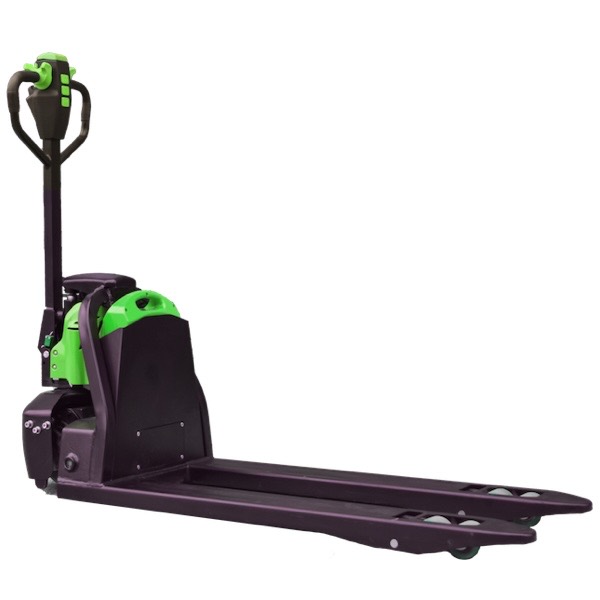
On the smaller trucks there is a second option: a quick-release pack that comes out in seconds and is swapped for a charged one. It suits operations where the truck cannot stand still long enough to charge — cold stores, delivery vehicles, sites with no convenient socket. Our pedestrian pallet trucks are built for this, with the pack in a cap-type box on top of the chassis rather than buried in it.
Charging in place is simpler and cheaper. Swapping is faster. Which is right depends entirely on whether your trucks ever get to stop.
6. Temperature
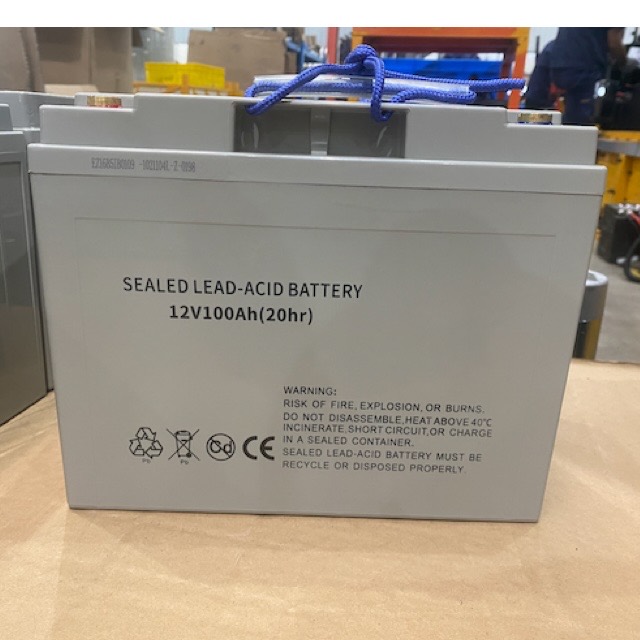
Lithium cells discharge happily over a wide range but are fussy about charging cold. As a rule of thumb, charge between roughly 0 °C and 45 °C and discharge from about −20 °C upwards; below freezing, a standard pack will either charge very slowly or refuse until it has warmed up. Cold-store work is not a reason to avoid lithium, but it is a reason to say so before you order — a heated pack, or charging the truck outside the chamber, has to be designed in rather than added later.
7. What it costs over the life of the truck
A lithium pack costs more on day one. It usually wins anyway, and the reasons are boring rather than dramatic: no second battery, no changing equipment, no charging room, no watering, no downtime waiting for a charge, and a pack that is typically good for several times the cycles of a lead-acid one. On a truck that works one light shift a day and sits still the rest of the time, none of those savings appear — and lead-acid is the right answer.
The benefits, in plain terms
- Charges in about an hour, and can be topped up in the gaps between jobs
- No battery changing, so no second battery, no changing station and no floor space for either
- No watering, no gassing, no ventilated charging room, no acid
- Far more charge cycles than lead-acid, so the pack usually outlives more than one set of tyres
- Holds its voltage as it empties, so the truck is as quick at 20% charge as at 90%
- Takes back braking energy efficiently, which adds a little run time on every ramp
- Lighter for the same energy — useful on trucks that go into vehicles or up mezzanines
- No emissions at the point of use, and much less heat in the aisle
When lead-acid is still the right choice
We build both, and we will say so plainly: if a truck does a few hours of light work a day, sits on charge all night and never runs out, lead-acid does that job for less money. Lithium earns its price where the truck is busy — two shifts, a tight turnaround, a cold store, or a job where stopping to change a battery costs more than the battery does.
What we fit
Accelift is a manufacturer, not a rebadger, so the pack, the charger and the truck are specified together rather than bolted to each other afterwards. On pedestrian pallet trucks we build 24 V packs at 20, 30 and 40 Ah and 48 V packs at 10, 15 and 20 Ah, with a quick-release box and a choice of external chargers; stackers, reach trucks and counterbalanced trucks scale up from there. OEM and private-label builds are normal work for us, including customer-specified cells, connectors and charger types.
Tell us the shift pattern, the temperature and how long the truck is allowed to stand still, and we will tell you which battery to put in it — including when the answer is lead-acid.
Want the lithium version of a truck you have already seen? Send us the model and the duty cycle and we will come back with a pack, a charger and a price.