
Every electric pallet truck moves a pallet from A to B. What separates them is where the operator stands, and that single choice changes the price, the size, the battery, the aisle it needs and how many fit in a container. Here is how to decide.
The question that answers it: metres per hour
Forget capacity for a moment. The variable that decides the operator position is how far the truck travels in an hour.
- Under about 500 m per hour — pedestrian. A walking operator is not the bottleneck at this distance, and everything else about a pedestrian truck is cheaper.
- 500 to 1,500 m per hour — stand-on platform. This is where the operator starts losing time and energy to walking.
- Over 1,500 m per hour — rider. Long runs, big distribution centres, cross-dock work.
Count it once, honestly, for a real shift. Most warehouses guess high; some guess very low.
Pedestrian (walkie)
The operator walks behind the tiller. Lightest, narrowest, cheapest, and by far the most common truck we build.
Typical specification at 1.5 t: a 24 V battery in the 75–100 Ah range, a 0.75 kW drive motor, travel speed around 4.2–4.5 km/h. Lithium versions of the same chassis run a much smaller pack because the truck is not carrying the operator.
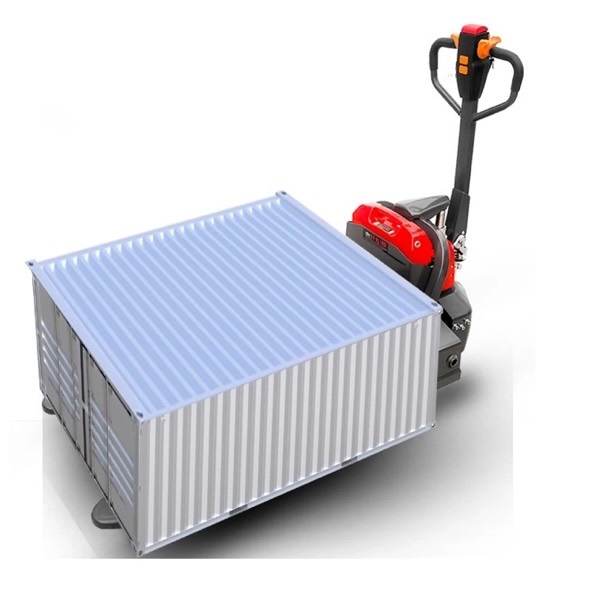
The commercial argument nobody mentions: a pedestrian pallet truck has no mast and no platform, so it packs flat. We fit 114 of them in a 40 ft container — and up to 140 of the compact lithium version. That is the lowest landed cost per unit in the whole range, by a wide margin.
Stand-on (with platform)
A fold-down platform with restraint arms, so the operator rides rather than walks. Fold it up and the truck works as a pedestrian model in tight spots.
Typical specification at 2.0 t: a 24 V/210 Ah battery, a 1.5 kW AC drive motor, electric power steering, travel speed around 5.2–5.5 km/h laden. Service weight roughly doubles compared with a basic pedestrian truck, because the chassis carries a much larger battery.
The cost of that comfort is container space: a platform model takes far more room, and we fit around 22 to 44 per 40 ft container depending on the model. Landed cost per unit is several times a pedestrian truck. That is not a reason to avoid it — it is a reason to order it only where the distance justifies it.
Rider (seated)
The operator sits. This is a long-distance machine: 3.0 t capacity, 24 V/270 Ah battery, a 3.0 kW drive motor, travel speeds around 7.5–8.0 km/h.
Buy one when the truck runs a full shift over long distances, or when the operator is handling heavy pallets continuously. In a small warehouse it is simply a large machine that is hard to manoeuvre.
Battery: match it to the operator position, not to the brochure
Battery size on these trucks correlates with how hard the truck works, not with how much it lifts:
- Pedestrian, light duty — 24 V / 75–100 Ah
- Pedestrian, full shift — 24 V / 100–120 Ah
- Stand-on — 24 V / 210 Ah
- Rider — 24 V / 270 Ah and up
Lithium changes the arithmetic rather than the ranking: a lithium truck can run a smaller pack because it charges in breaks instead of needing to survive the whole shift. It is worth the premium when you run more than one shift, or when you have nowhere to put a ventilated charging room.
What else changes with the operator position
| Pedestrian | Stand-on | Rider | |
|---|---|---|---|
| Typical capacity | 1.5–3.0 t | 2.0–3.0 t | 3.0 t |
| Travel speed, laden | ~4.2 km/h | ~5.2 km/h | ~7.5 km/h |
| Drive motor | 0.75–1.2 kW | 1.3–1.5 kW | 3.0 kW |
| Battery | 24 V / 75–120 Ah | 24 V / 210 Ah | 24 V / 270 Ah |
| Units per 40 ft container | 114–140 | 22–44 | 22 |
A note for dealers
If you are stocking rather than buying for your own warehouse, the container figures above are the whole business case. A container of pedestrian trucks gives you a hundred-plus units of stock at a low cost each — inventory you can turn quickly and sell from the shelf. A container of platform and rider models gives you twenty-odd units at several times the cost, which you generally sell to order rather than from stock.
Most dealers we work with end up running both: pedestrian trucks as stock, larger models against firm orders, mixed into the same container.
Still not sure?
Send us three numbers — metres travelled per hour, heaviest pallet, and number of shifts — and we will tell you which of the three is right, including when the answer is the cheapest one.
Accelift builds electric pallet trucks from 1.5 to 3.0 tonnes at its own factory in Huzhou, Zhejiang, in pedestrian, stand-on and rider versions, with lead-acid or lithium batteries.