
Solution · Hygienic and corrosive environments
A painted pallet truck does not last long in a fish room, a wash-down food line or a chemical plant. It is not the motor that fails first — it is the paint, and then everything under it. This is what we build instead.
Why a normal pallet truck fails in these rooms
Every wet or chemically aggressive process shares the same pattern. Water and cleaning agents get into the seams; paint lifts at the fork edges and the chassis welds; rust follows; and once rust starts, the truck becomes a problem for the hygiene audit rather than a tool. In cold stores the cycle is faster still, because condensation forms every time the truck moves between temperatures.
Repainting buys a few months. Stainless steel removes the failure mode instead of postponing it.
Where this truck is used
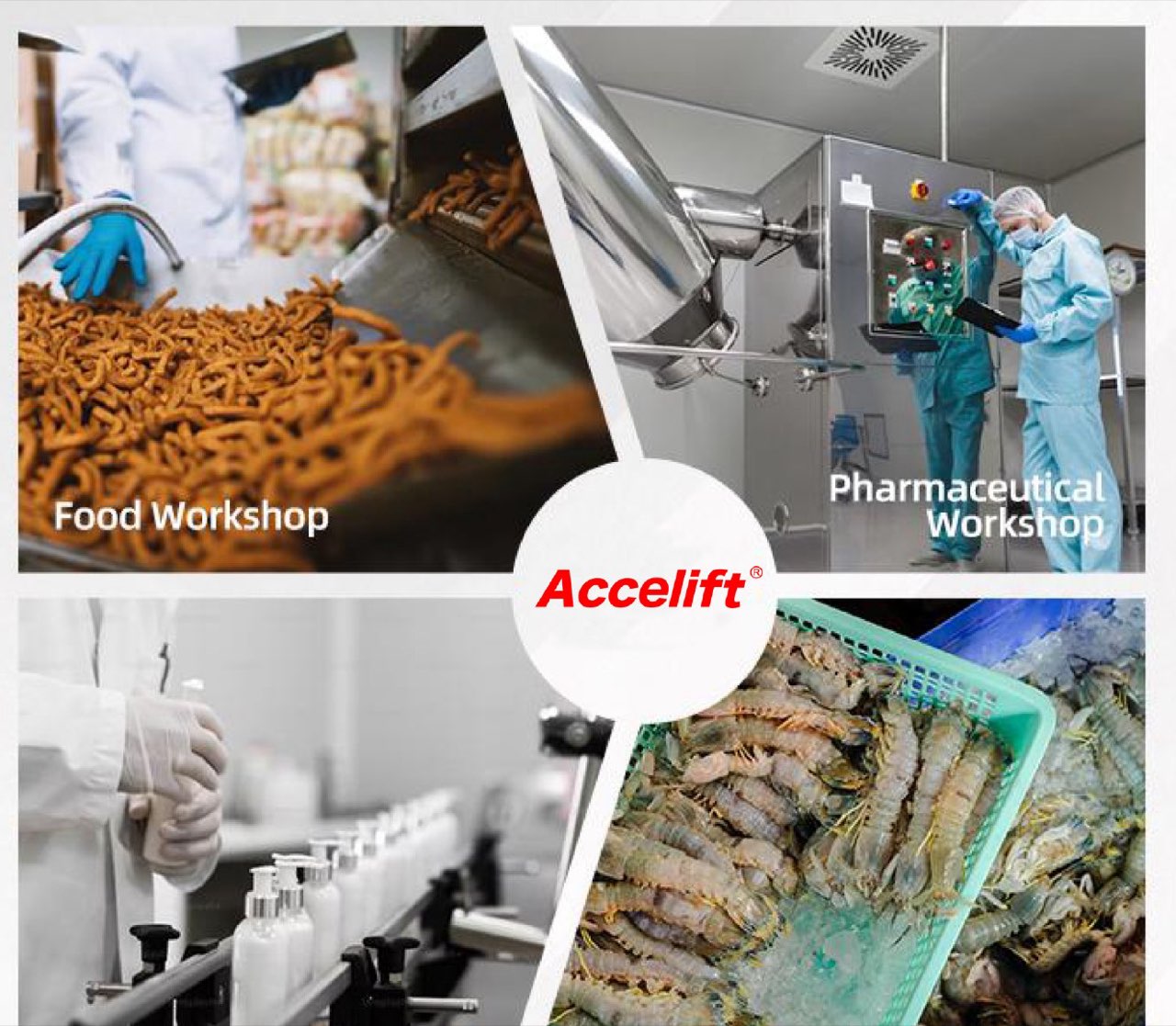
Four environments account for most of what we ship:
- Food workshops — open product, daily wash-down, and inspectors who look at equipment as closely as they look at the product.
- Pharmaceutical production — clean rooms where a flaking painted surface is a contamination source, not a cosmetic issue.
- Chemical plants — splash and vapour that strip conventional coatings.
- Aquatic and cold storage — brine, ice melt and constant condensation, the hardest combination of the four.
304 stainless, and the parts you cannot see
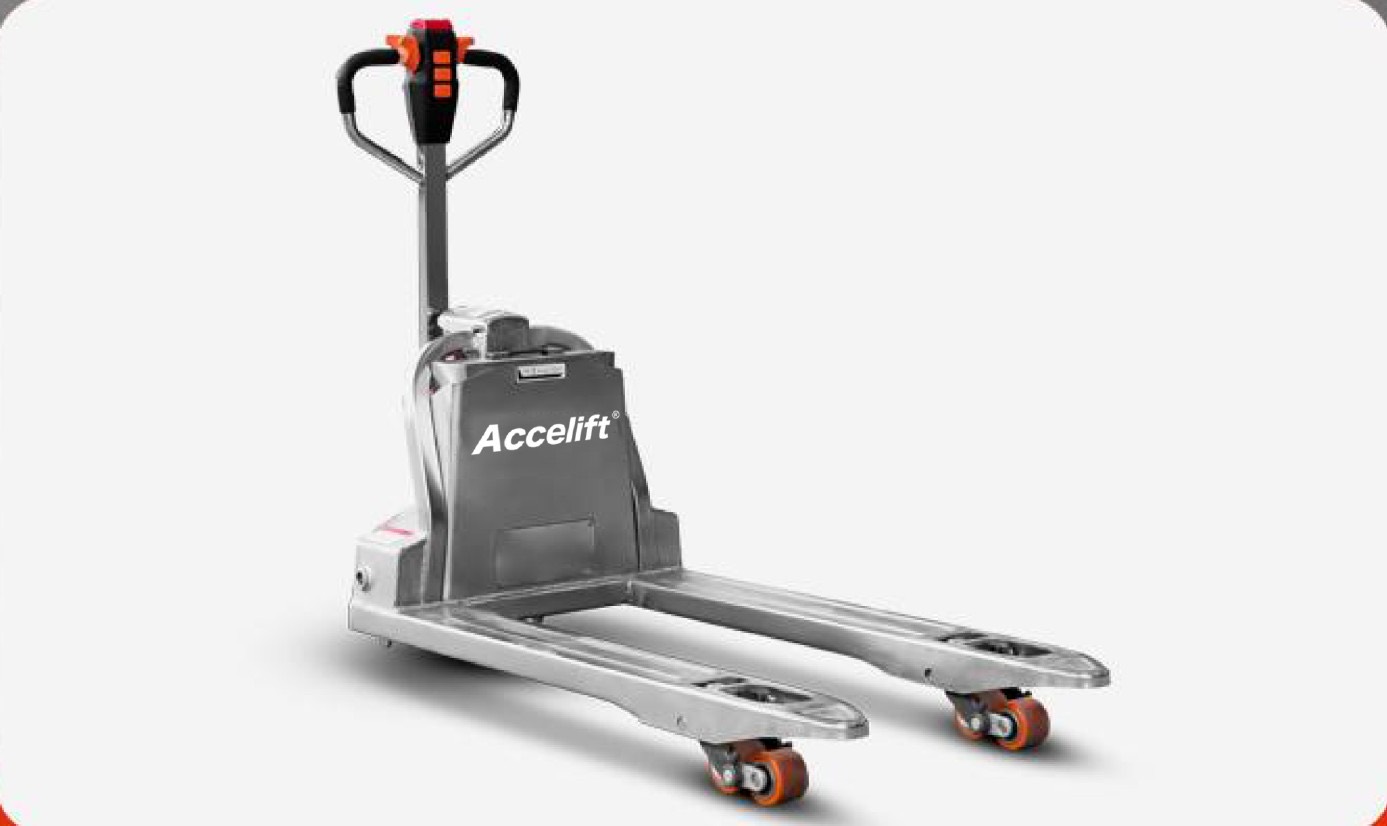
The visible answer is the shell: 304 food-grade stainless steel, chosen for corrosion resistance, high-temperature tolerance and oxidation resistance, and because it can be cleaned properly rather than merely wiped.
The parts that matter just as much are inside:
- Fully sealed hydraulic cylinder. No oil leakage. In a dry warehouse an oil weep is a housekeeping job; over a food line it is a batch write-off.
- Lithium battery instead of lead-acid. No electrolyte to spill, no watering, no acid mist — and it takes a partial charge whenever the truck is standing, which suits shift work in a cold store better than a fixed charging cycle.
- Metal drive-unit cover. Protects the drive system and gives the operator’s feet some protection at the same time.
- Precision steel spring and thickened ring rod. Thicker section, more shock absorption, a more stable connection under load.
- Double load wheels. The fork tips do not tilt left or right as the load transfers — the failure that causes most near-misses with single-wheel forks.
- Belly-stop switch in the tiller head. If the truck backs the operator towards a wall, leaning into the switch cuts the drive. No hand needs to find a button.
SL15L3E-S / SL20L3E-S — technical data
1500 or 2000 kg, 200 mm lift, 1398 mm turning radius, and a service weight of about 142 kg — light enough to be manoeuvred by hand when it has to be.
| Parameter | Unit | SL15L3E-S | SL20L3E-S |
| Characteristics | |||
| Driving mode | Electric | ||
| Operation | Pedestrian | ||
| Rated capacity | Q (kg) | 1500 | 2000 |
| Load centre | c (mm) | 600 | |
| Front overhang | x (mm) | 944 | |
| Wheel base | y (mm) | 1243 | |
| Service weight with battery | kg | 142 | 146 |
| Wheels and tyres | |||
| Tyre type | Polyurethane (PU) | ||
| Drive wheel size | Φ × w (mm) | Φ210 × 70 | |
| Load wheel size | Φ × w (mm) | Φ80 × 60 | |
| Wheels, drive / balance / load (x = driven) | 1x / 4 | ||
| Wheel distance, load end | b11 (mm) | 400 / 535 | |
| Dimensions | |||
| Lift height | h3 (mm) | 200 | |
| Tiller height, min. / max. | h14 (mm) | 740 / 1160 | |
| Fork lowered height | h13 (mm) | 85 | |
| Overall length | l1 (mm) | 1603 | |
| Body length | l2 (mm) | 453 | |
| Overall width | b1/b2 (mm) | 550 / 685 | |
| Fork size | s/l/e (mm) | 50 / 150 / 1150 | |
| Fork outer width | b5 (mm) | 550 / 685 | |
| Ground clearance, at wheelbase centre | m2 (mm) | 35 | |
| Aisle width, pallet 1000 x 1200 across forks | Ast (mm) | 1804 | |
| Aisle width, pallet 800 x 1200 along forks | Ast (mm) | 1854 | |
| Turning radius | Wa (mm) | 1398 | |
| Performance | |||
| Travel speed, laden / unladen | km/h | 4.2 / 4.5 | |
| Gradeability, laden / unladen | % | 5 / 10 | |
| Service brake | Electromagnetic | ||
| Drive | |||
| Drive motor power | kW | 0.75 | |
| Lift motor power | kW | 0.5 | 0.8 |
| Battery voltage / capacity | V/Ah | 24/20 · 24/30 · 24/40 · 24/60 · 48/15 · 48/20 | |
| Battery weight (± 5%) | kg | 6 – 13.2 depending on pack | |
| Other | |||
| Drive control | DC speed control | ||
| Noise level at operator’s ear | dB(A) | ≤ 70 | |
| Steering | Mechanical | ||
When stainless is the wrong answer
If the truck lives in a dry warehouse and never meets water or chemicals, stainless is money spent on a problem you do not have. A painted truck with the same drive and the same battery will do the identical job for noticeably less. We would rather say that now than sell you a specification you did not need.
The test is simple: does the truck get washed down, does it work near open product, or does it move between temperatures? One yes is usually enough.
Talk to the factory
Tell us the environment, the heaviest pallet, and how many hours a day the truck is live. We will come back with a capacity, a battery pack and a price — and if a painted truck would serve you just as well, we will say so.
SL15L3E-S / SL20L3E-S product page →
See the full electric pallet truck range →
Guide: choosing an electric pallet truck →