
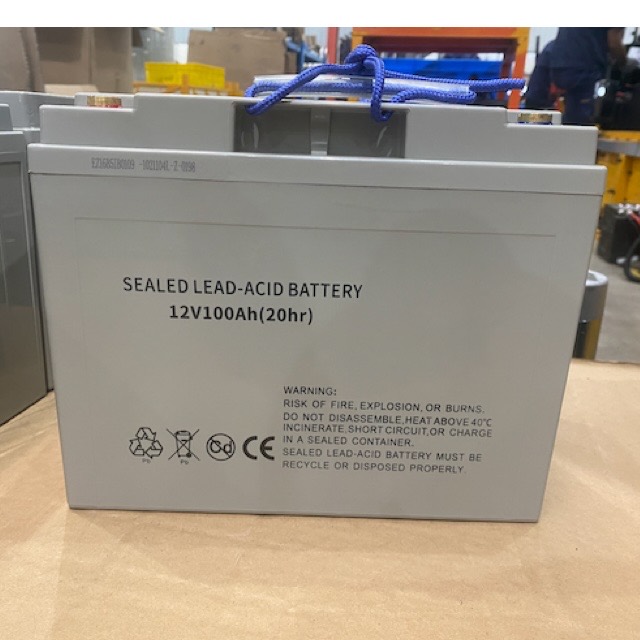
Almost every comparison of lead-acid and lithium starts with the price of the battery. That is the one number that tells you least. Here is how to work out what each one will actually cost you over five years, and a rule for deciding without a spreadsheet.
First, stop comparing amp-hours
Amp-hours only mean something at a given voltage. Compare watt-hours: volts × amp-hours. Some real packs from our own range:
| Pack | Nominal energy |
|---|---|
| 24 V / 75 Ah | 1,800 Wh |
| 24 V / 100 Ah | 2,400 Wh |
| 24 V / 120 Ah | 2,880 Wh |
| 24 V / 210 Ah | 5,040 Wh |
| 48 V / 65 Ah | 3,120 Wh |
A 48 V / 65 Ah pack holds more energy than a 24 V / 120 Ah pack, even though the amp-hour figure is half. Voltage is not a quality rating — it is half of the sum.
Then correct for usable energy
This is the step that gets skipped, and it changes the answer.
Lead-acid should not be run flat. Regularly discharging past about half of its capacity shortens its life sharply. In practice you plan around 50–60% of nominal as usable energy.
Lithium tolerates deep discharge. Plan around 80–90% of nominal.
So a 2,400 Wh lead-acid pack gives you roughly 1,200–1,400 Wh of work. To match it, a lithium pack needs only about 1,500–1,700 Wh nominal. Lithium wins on paper before any cost is counted — which is exactly why the next section matters.
The trap: cheap lithium with a small pack
There are lithium pallet trucks on the market that cost less than the lead-acid version of the same machine. That is not a bargain; it is a different machine.
We build both. Our compact lithium pallet truck carries a 24 V / 20 Ah pack — 480 Wh nominal, perhaps 400 Wh usable. The lead-acid version of a similar truck carries 24 V / 75 Ah — 1,800 Wh nominal, around 1,000 Wh usable. The lithium truck holds roughly 40% of the working energy.
That is a perfectly good machine for light, intermittent duty — a shop, a small store room, a van-delivery operation where the truck does twenty pallets a day and charges overnight. It is not a replacement for a full-shift truck, and a supplier who lets you believe it is has sold you a problem.
Rule: before comparing prices, compare usable watt-hours. If the lithium option is cheaper, check whether the pack is smaller. Usually it is.
What lead-acid costs beyond the purchase price
- Watering. Flooded cells need topping up, on a schedule, by somebody. Miss it often enough and the battery is finished early.
- A charging area. Charging produces hydrogen, so the area needs ventilation. If you do not have one, the cost of the battery includes building one.
- Charging time. A full charge takes most of a working day, and the battery then wants time to cool. You cannot usefully top it up in a coffee break — opportunity charging is what kills lead-acid batteries fastest.
- A second battery, for more than one shift. Plus the means to change it: a stand, a transfer trolley, and a person trained to do it. On a small truck a pack can weigh 150–200 kg.
- Replacement. Plan on three to four years in normal single-shift use, less if it is regularly run flat.
What lithium costs beyond the purchase price
- A higher price for the same usable energy, once you compare like for like.
- Its own charger. A lithium pack and a lead-acid charger are not interchangeable. If you run a mixed fleet you now have two charger types on the wall.
- Cold-store behaviour. Lithium cells lose usable capacity in the cold, and most packs will not accept a charge below freezing without a heater. If your work is in a freezer, ask specifically what the pack does at your temperature.
- The BMS. The battery management system is the part that most often fails, and it is not a generic component. A lead-acid battery can be replaced from a local supplier almost anywhere; a lithium pack usually comes back to the manufacturer.
- Shipping. Lithium batteries are regulated dangerous goods. It affects how spare packs are shipped and what they cost to send.
The five-year worksheet
Fill this in with your own numbers rather than anyone else’s averages. Do it twice, once per technology.
- Truck price, with the battery you actually need (matched on usable watt-hours)
- Charger price
- Second battery and changing equipment, if you run more than one shift
- Cost of a ventilated charging area, if you do not already have one
- Replacement batteries over five years
- Watering and maintenance labour: minutes per week × 260 weeks × your labour rate
- Electricity: lithium charging is meaningfully more efficient, so this line is not zero
- Downtime: hours per year the truck is unavailable because the battery is charging or cooling × what an hour of that truck is worth
- Residual value at year five
Line 8 is the one that usually decides it, and the one people leave out.
The rule, if you do not want to fill in a worksheet
Choose lead-acid when you run one shift, you already have somewhere to charge, and the truck sits idle for most of the night. For a large share of warehouses this is still the cheaper answer over five years, and anyone telling you otherwise is selling.
Choose lithium when any one of these is true:
- You run more than one shift and cannot spare the time to swap a battery
- You have nowhere to put a ventilated charging room, and building one would cost more than the battery premium
- The truck works in short bursts across a long day, so it can charge in the gaps
- Nobody in the building will reliably water a battery
Cold store is the case where it goes either way — ask for the specific figures at your temperature before deciding.
Three questions to ask your supplier
- What is the nominal and usable energy of the pack, in watt-hours?
- How many charge cycles is the battery rated for, and at what depth of discharge?
- If the BMS fails in year three, what happens — and who pays?
A supplier who answers all three without hesitating has thought about the battery. One who answers with a slogan has not.
Accelift builds electric pallet trucks and stackers with both lead-acid and lithium packs at its own factory in Huzhou, Zhejiang. Tell us your shift pattern and the metres your truck covers in an hour, and we will tell you which one costs you less — including when the answer is lead-acid.