
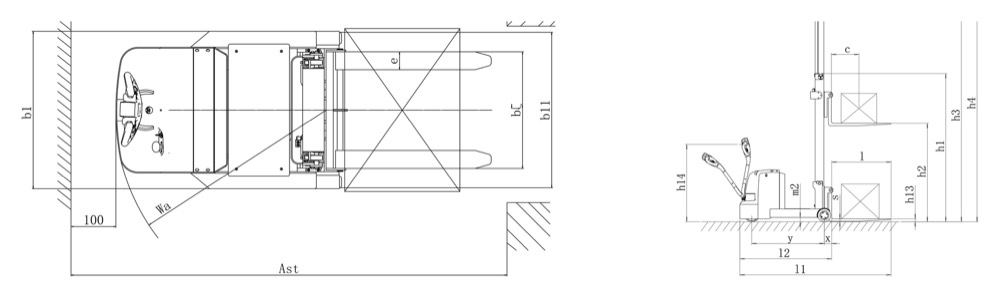
Every warehouse truck spec sheet in the world uses the same letter codes — h1, h3, Ast, Wa, b10 — because they come from a shared standard. Almost nobody explains them. Here is what each one means and, more usefully, which ones will cause you a problem if you ignore them.
All the example numbers below are from stackers we actually build.
The load block
Q — rated capacity. How much the truck lifts, in kg or tonnes. Always quoted together with:
c — load centre, almost always 600 mm. This assumes the weight of the pallet sits 600 mm forward of the fork face. Long or front-heavy loads shift that centre outward, and real capacity falls.
x — axle centre to fork face, typically 675–780 mm, combined with y — wheelbase, typically 1,128–1,200 mm. Together these determine stability. A short wheelbase turns tighter; a long one is steadier with a high load. That is the trade-off you are buying into, whether or not anyone points it out.
The heights — the ones that cause problems
h1 — mast lowered. The single most-ignored number on the sheet. Check it against your lowest doorway and your container door. Examples from our range: 1,486 mm for a 2,000 mm lift; 2,236 mm for a 3,500 mm lift. That 750 mm difference decides whether the truck fits through your bay door.
h2 — free lift. How far the forks rise before the mast starts to extend. Zero on most standard stackers. It matters in one situation: loading inside a container or under a low beam. If that is your job, you need a free-lift mast and you must ask for it by name.
h3 — lift height. The number everyone looks for. How high the forks go.
h4 — mast extended. h1 plus the mast travel. Check against ceiling, sprinklers and lighting. On a two-stage mast the pattern is consistent: h4 is roughly h3 plus 440 mm across an entire series. If a spec sheet breaks that pattern on one column and not the others, ask the manufacturer to confirm the figure before you order — a typo in a table is not a design feature.
h13 — lowered fork height, typically 86–90 mm. Matters for closed-bottom pallets and skids.
h14 — tiller height, min/max, for example 970/1330 mm. Operator ergonomics.
The widths
b1/b2 — overall width. Typically 808–820 mm on a 1.5 t stacker. Combined with Ast, this decides whether the truck fits your layout.
b5 — width across the forks, often given as a pair such as 570/695 mm, meaning the forks are adjustable between those settings. Check it against your pallet.
b10 / b11 — track width, drive end and load end. 592–646 mm and 410/535 mm are typical. Relevant for floor loading and for dock plates.
s/e/l — fork dimensions: thickness, width, length. 60/160/1150 mm is standard. A 1,150 mm fork under a 1,200 mm pallet is normal — the fork is not meant to protrude.
The ones that decide whether the truck fits at all
Ast — minimum aisle width. Given twice: once for a 1000 × 1200 pallet across the forks, once for 800 × 1200 along the forks. Typical values 2,190–2,530 mm. Read the line that matches your pallet, then add 200–300 mm.
Wa — turning radius. 1,340–1,570 mm across our range. Two trucks with the same capacity and the same lift can differ by 230 mm here, entirely because of where the drive unit sits in the chassis.
m2 — ground clearance at the centre of the wheelbase, typically 26–35 mm. On broken concrete or a steep dock plate, this is the number that grounds the truck.
Performance
Travel speed, laden/unladen — 4.2/4.5 to 5.2/5.5 km/h. The gap between the two tells you how hard the drive works under load.
Lifting and lowering speed — quoted with and without load. Note that lowering is often faster unladen than laden on some hydraulic-descent designs, and the reverse on others. Neither is wrong; both figures should be on the sheet.
Gradeability, laden/unladen — 3/6% to 6/10%. Compare against your ramp before you buy.
Drive and battery
Drive motor, 60-minute rating — 0.75 to 2.5 kW. The 60-minute rating is a continuous-duty figure, not a peak.
Lift motor at S3 15% — typically 2.2–3.0 kW. S3 15% means intermittent duty: 15% on, 85% off, over a 10-minute cycle. Lifting is intermittent by nature, so this is the honest way to rate it.
Battery voltage and capacity — 24 V/120 Ah and 48 V/65 Ah are both common. Higher voltage means lower current for the same power, which means less heat and better sustained performance. Do not compare voltages alone: compare watt-hours (volts × amp-hours). 24 V × 120 Ah = 2,880 Wh; 48 V × 65 Ah = 3,120 Wh.
The three numbers to check first
If you read nothing else on the sheet:
- Ast — does it fit your aisle, plus 200 mm?
- h1 — does it fit under your lowest door?
- Gradeability laden — does it get up your ramp with a pallet on?
Everything else can be worked around. Those three cannot.
Accelift builds electric pallet trucks and stackers at its own factory in Huzhou, Zhejiang. Full spec sheets for every model are on the product pages, including the lines most catalogues leave out.